

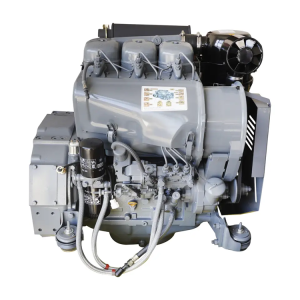
A water cooled diesel engine continuously removes high-temperature heat generated during operation through forced circulation of coolant, ensuring stable operation within the optimal temperature range (typically 80–95℃). With the water pump as the power core, combined with intelligent thermostatic regulation, high-efficiency heat dissipation via the radiator, and auxiliary cooling by the fan, it forms a closed-loop temperature control cycle, which is a mature cooling solution widely adopted in modern medium and high-power diesel engines.
I. System Composition and Functions of Core Components
The cooling system of a water cooled diesel engine mainly consists of the following key components, each performing its own duty to collaboratively complete thermal management:
Water Pump
Usually designed as a centrifugal type, it is driven by the crankshaft via a belt and provides the pressure and flow required for coolant circulation. It draws coolant from the radiator, pressurizes it, and delivers it into the engine water jackets to realize forced circulation.
Radiator
Composed of an upper tank, a lower tank, and a radiator core, coolant flows through the core tubes while external air, driven by the fan or natural airflow, carries away heat. The radiator cap is equipped with a pressure valve and a vacuum valve to regulate system pressure, raise the boiling point of coolant, and prevent cracking due to expansion.
Thermostat
Installed in the engine outlet pipeline, it automatically adjusts the circulation path according to the coolant temperature. When the engine is cold, it closes the main circuit, allowing coolant to circulate only inside the engine (small circuit) for faster warm-up; after reaching the set temperature, it opens the main circuit to connect the radiator for heat dissipation.
Cooling Fan
Located behind the radiator, it is mostly driven by the crankshaft or an electric motor. It actively increases airflow at low speeds or idle speed to enhance heat dissipation efficiency, and its start and stop are usually controlled by a water temperature sensor.
Water Jackets
Closed water channels cast inside the cylinder block and cylinder head, through which coolant flows to directly absorb heat from high-temperature components such as the combustion chamber, piston, and valves.
Auxiliary Devices
Including an expansion tank (to compensate for thermal expansion and contraction of coolant), temperature control switches, oil coolers, etc., which further optimize temperature control and system reliability.
II. Working Cycles: Small Circuit and Main Circuit
The operation of the cooling system is divided into two stages, automatically switched by the thermostat:
Cold Engine Stage: Small Circuit
At the initial start-up stage, the coolant temperature is below 70–80℃, and the thermostat valve is closed.Coolant circulates only between the water pump → water jackets → thermostat bypass pipe → water pump, without passing through the radiator.
Purpose: Rapidly raise the engine temperature, shorten warm-up time, reduce wear and emissions.
Normal Operation: Main Circuit
When the coolant temperature rises to the thermostat opening temperature (e.g., fully open at 83℃), the valve opens.High-temperature coolant flows through the thermostat to the radiator, where it is cooled by the fan and airflow, then pumped back to the engine by the water pump.
It achieves continuous and efficient heat dissipation, maintaining the engine within the optimal operating range of 85–95℃.
III. Cooling Medium and System Types
Coolant
Generally antifreeze (ethylene glycol + water), featuring high specific heat capacity, antifreeze, anti-boiling, and anti-corrosion properties. It is mandatory in cold regions to avoid pipeline cracking caused by freezing.
System Types
Closed-loop circulation: Coolant circulates in a sealed circuit and dissipates heat through a radiator, suitable for land-use diesel engines and automobiles.
Open-loop circulation: Directly draws external water sources (e.g., river water, seawater) for cooling and discharges it after use, commonly used in marine applications.
Central cooling system: Adopts dual freshwater circuits (high and low temperature) for heat exchange with seawater via intercoolers, reducing components in contact with seawater and lowering corrosion risks, mostly applied in large marine diesel engines.