

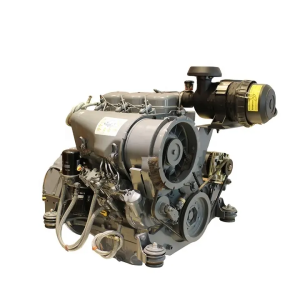
Water cooled diesel engines feature excellent overall durability. They are the mainstream high-reliability option for heavy-duty continuous operation scenarios such as industry, engineering and marine applications. With proper maintenance, their service life is much longer than air-cooled models of the same power rating.
Under normal working conditions, the whole engine can serve up to 15 years, with an accumulated operating hour range of 8,000–15,000 hours, equivalent to approximately 200,000 kilometers for vehicle use. Well-maintained premium industrial units can even achieve over 20,000 operating hours without major overhaul.
At the same power output, water-cooled diesel engines have roughly 40% longer service life than air-cooled ones. Typical service life of air-cooled engines is only 5,000–8,000 hours. The stable temperature control of water cooled designs greatly reduces component wear rates.
The circulating water cooling system stabilizes engine operating temperature within the optimal range of 65℃–95℃. It prevents abnormal wear of pistons and cylinder liners caused by local overheating, slows down oil aging significantly, and keeps components operating under low-loss conditions.
They have strong load adaptability. During long-time full-load continuous operation, temperature will not spike due to insufficient heat dissipation like air-cooled engines. Their anti-fatigue performance under heavy loads is far superior, suitable for 24-hour continuous operation of generators and construction machinery.
In winter, hot water can be filled for rapid preheating before startup, which greatly reduces wear during cold start and avoids premature damage caused by dry friction of parts in cold conditions for air-cooled engines.
Regularly inspect the operating status of water pumps, thermostats and fan belts of water-cooled diesel engines to prevent overheating damage caused by sudden cooling system failures. When ambient temperature drops below 0℃ in winter, antifreeze must be added to prevent cracking of the water tank.
Operate in strict accordance with specifications: idle for warm-up after startup and idle for cooling before shutdown. Avoid long-time harsh revving and prolonged overload operation to further extend the service life before major overhaul.